Bifenazate (Floramite)
CAS149877-41-8
Bifenazate (Floramite) (CAS 149877-41-8, C17H20N2O3) is supplied by ChemSigma for research and manufacturing, with specification, analytical methods and batch documentation available on request.
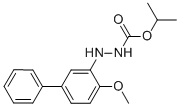
- CAS No.
- 149877-41-8
- Formula
- C17H20N2O3
- Mol. weight
- 129 g/mol
- Appearance
- Yellow crystal
Chemical Specifications
Identifiers
| CAS number | 149877-41-8 |
|---|---|
| Product name | Bifenazate (Floramite) |
| Chinese name | 联苯肼酯 |
| Synonyms | Acramite; Bifenazate; D 2341; Floramite; Hydrazinecarboxylic acid, 2-(4-methoxy[1,1'-biphenyl]-3-yl)-, 1-methylethyl ester; Isopropyl 3-(4-methoxy-3-biphenylyl)carbazate |
| Chinese synonyms | 联苯肼酯; 联苯肼酯溶液,100PPM; N′-(4-甲氧基联苯-3-基)肼羧酸异丙酯 |
| Molecular formula | C17H20N2O3 |
| Molecular weight | 129 g/mol |
| EC number | 442-820-5 |
Physical and chemical properties
| Appearance | Yellow crystal |
|---|---|
| Melting Point | 119~121 ( ℃ ) |
Applications
Application Sites: Floramite is registered for control of mite pests on greenhouse, shadehouse, nursery, field, landscape and interiorscape grown ornamentals. <br>Types of Formulation: 91.7% <br>technical product; 50% wettable powder end<br>use product packaged in water soluble bags<br>Types and Methods Ground application using standard commercial of Application: sprayers Application Rates: Application rates 2 to 4 oz.(1 to 2 oz. active ingredient) in 100 gallons of water, applied as a full coverage spray using a minimum volume of 1-2 qts. of final solution per 100 sq. ft. Residual control of<BR>up to 21 days. Not to be used in successive applications, only between applications of at least<BR>two products of alternative chemical classes.Carrier: Water<br>Summary Statement: Bifenazate possesses low acute toxicity by all routes of exposure (Category IV ) with no evidence of dermal sensitization potential. It is non-irritating to skin and minimally irritating to eyes. Bifenazate is negative for mutagenic potential in a battery of required mutagenicity studies. Bifenazate has not yet received a human carcinogen classification since bifenazate is being considered as a non-food use pesticide and both the mouse and rat chronic toxicity/carcinogenicity studies are not required at this time. Occupational exposure to those working in a nursery or greenhouse environment is the primary source for human exposure. The MOE for post-application exposures is 114. Since bifenazate has no dietary or residential uses, an aggregate risk assessment was not required. Based on expected use<BR>pattern information bifenazate is neither mobile or persistent in the aquatic and soil environment. Bifenazate would be expected to exhibit low potential to contaminate ground and surface waters.
Packaging, Storage & Transport
| Available pack sizes | 5kg, 1kg, 500g, 100g, 50g, 10g |
|---|
Read the current safety data sheet before handling. Packaging can be adapted to the order quantity and destination.
Frequently Asked Questions
What is the CAS number of Bifenazate (Floramite)?
The CAS Registry Number of Bifenazate (Floramite) is 149877-41-8. Bifenazate (Floramite) is also known as Acramite; Bifenazate; D 2341.
What is the molecular formula and molecular weight of Bifenazate (Floramite)?
The molecular formula of Bifenazate (Floramite) is C17H20N2O3, and its molecular weight is 129 g/mol.
What is Bifenazate (Floramite) used for?
Application Sites: Floramite is registered for control of mite pests on greenhouse, shadehouse, nursery, field, landscape and interiorscape grown ornamentals. <br>Types of Formulation: 91.7% <br>technical product; 50% wettable powder end<br>use product packaged in water soluble bags<br>Types and Methods Ground application using standard commercial of Application: sprayers Application Rates: Application rates 2 to 4 oz.(1 to 2 oz. active ingredient) in 100 gallons of water, applied as a full coverage spray using a minimum volume of 1-2 qts. of final solution per 100 sq. ft. Residual control of<BR>up to 21 days. Not to be used in successive applications, only between applications of at least<BR>two products of alternative chemical classes.Carrier: Water<br>Summary Statement: Bifenazate possesses low acute toxicity by all routes of exposure (Category IV ) with no evidence of dermal sensitization potential. It is non-irritating to skin and minimally irritating to eyes. Bifenazate is negative for mutagenic potential in a battery of required mutagenicity studies. Bifenazate has not yet received a human carcinogen classification since bifenazate is being considered as a non-food use pesticide and both the mouse and rat chronic toxicity/carcinogenicity studies are not required at this time. Occupational exposure to those working in a nursery or greenhouse environment is the primary source for human exposure. The MOE for post-application exposures is 114. Since bifenazate has no dietary or residential uses, an aggregate risk assessment was not required. Based on expected use<BR>pattern information bifenazate is neither mobile or persistent in the aquatic and soil environment. Bifenazate would be expected to exhibit low potential to contaminate ground and surface waters.
How can I request a quotation for Bifenazate (Floramite)?
Send an inquiry for Bifenazate (Floramite) (CAS 149877-41-8) with the required quantity, target specification, destination country and any documentation requirements. ChemSigma will confirm availability, packaging, lead time and price.
Request a Quote for Bifenazate (Floramite)
Tell us the required quantity, target specification, destination country and any documentation requirements. We will confirm availability, packaging, lead time and price.
Need custom synthesis or scale-up? Our group company CKS Technology offers custom synthesis, process development and scale-up.