Acrylic Anhydride
CAS2051-76-5
Acrylic anhydride (CAS 2051-76-5) is the symmetric anhydride of acrylic acid, used to introduce the acryloyl group onto amines and alcohols to make acrylamides and acrylate esters. It releases acrylic acid rather than hydrogen chloride as the by-product, is moisture-sensitive and polymerizable, and is normally supplied with a polymerization inhibitor. King-Pharm supplies acrylic anhydride for research and production with a batch-specific certificate of analysis.
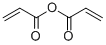
- CAS No.
- 2051-76-5
- Formula
- C6H6O3
- Mol. weight
- 126.11 g/mol
- Appearance
- Colorless to Yellow Liquid
Product Description
Acrylic anhydride (prop-2-enoyl prop-2-enoate, C6H6O3, MW 126.11) is a liquid acid anhydride bearing two vinyl carbonyl groups. Suppliers list a reduced-pressure boiling point, for example 67 °C at 10 mmHg (TCI).
It acts as an acryloyl donor: nucleophiles such as primary or secondary amines and alcohols attack one carbonyl group, giving the corresponding acrylamide or acrylate and one equivalent of acrylic acid. The retained C=C double bond can then take part in radical polymerization or Michael-type additions.
Compared with acryloyl chloride, the anhydride avoids generating hydrogen chloride, which suits acid-sensitive substrates and simplifies work-up; compared with methacrylic anhydride, it gives the unsubstituted acryloyl group, which is generally more reactive in polymerization and conjugate addition.
When purchasing, check assay, residual acrylic acid, the type and level of inhibitor (e.g. MEHQ), and water content. Because the material is moisture- and heat-sensitive, keep it refrigerated under inert gas and confirm that cold-chain handling fits your process.
Chemical Specifications
Identifiers
| CAS number | 2051-76-5 |
|---|---|
| Product name | Acrylic Anhydride |
| IUPAC name | prop-2-enoyl prop-2-enoate |
| Synonyms | Acrylic Acid Anhydride; 2-Propenoic Acid Anhydride; Acyrlic Acid Anhydride; Propenoic Anhydride; Diacrylic Anhydride; Prop-2-Enoyl Prop-2-Enoate |
| Molecular formula | C6H6O3 |
| Molecular weight | 126.11 g/mol |
| EC number | 218-128-2 |
| MDL number | MFCD00048146 |
| PubChem CID | 74919 |
| InChI | InChI=1/C6H6O3/c1-3-5(7)9-6(8)4-2/h3-4H,1-2H2 |
| InChIKey | ARJOQCYCJMAIFR-UHFFFAOYSA-N |
| SMILES | C=CC(=O)OC(=O)C=C |
Physical and chemical properties
| Appearance | Colorless to Yellow Liquid |
|---|
Applications
Acrylic anhydride is mainly used as an acryloylating agent in synthesis and materials work.
Acrylamide synthesis
N-Acryloylation of amines to prepare acrylamide monomers and intermediates.
Specialty acrylate monomers
O-Acryloylation of alcohols and phenols to make functional acrylate esters.
Polymer functionalization
Grafting polymerizable acryloyl groups onto hydroxyl- or amine-bearing polymers and materials.
Medicinal chemistry
Installing acrylamide groups on amine-containing scaffolds during route scouting.
Quality Documentation
The following documents can be provided for Acrylic Anhydride to support technical evaluation and purchasing. Documents are issued for the specific grade and batch supplied.
-
Certificate of Analysis (COA) Batch-specific test results against the specification.
-
Product specification The release specification with test items, limits and methods.
Packaging, Storage & Transport
| Available pack sizes | 5kg, 1kg, 500g, 100g, 50g, 10g |
|---|
Read the current safety data sheet before handling. Packaging can be adapted to the order quantity and destination.
Frequently Asked Questions
Acrylic anhydride or acryloyl chloride?
The anhydride releases acrylic acid instead of hydrogen chloride, so it is often chosen for acid-sensitive substrates or where chloride residues matter; acryloyl chloride is usually more reactive and cheaper per acryloyl unit.
How should acrylic anhydride be stored?
Keep it tightly closed, refrigerated (suppliers recommend 0–10 °C or 2–8 °C) under inert gas and away from moisture, heat and light; it contains an inhibitor and should not be stored without one.
What should be checked before use?
Check the inhibitor level and residual acrylic acid on the COA, use dry solvents and glassware, and add a base or scavenger if the acrylic acid by-product affects the reaction.
What is the CAS number of Acrylic Anhydride?
The CAS Registry Number of Acrylic Anhydride is 2051-76-5. Acrylic Anhydride is also known as Acrylic Acid Anhydride; 2-Propenoic Acid Anhydride; Acyrlic Acid Anhydride.
What is the molecular formula and molecular weight of Acrylic Anhydride?
The molecular formula of Acrylic Anhydride is C6H6O3, and its molecular weight is 126.11 g/mol.
What is Acrylic Anhydride used for?
Acrylic anhydride is mainly used as an acryloylating agent in synthesis and materials work.
Which quality documents are available for Acrylic Anhydride?
The following documents are available for Acrylic Anhydride: Certificate of Analysis (COA); Product specification. Contact ChemSigma to request the documents for a specific batch.
How can I request a quotation for Acrylic Anhydride?
Send an inquiry for Acrylic Anhydride (CAS 2051-76-5) with the required quantity, target specification, destination country and any documentation requirements. ChemSigma will confirm availability, packaging, lead time and price.
Related Products
Request a Quote for Acrylic Anhydride
Tell us the required quantity, target specification, destination country and any documentation requirements. We will confirm availability, packaging, lead time and price.
Need custom synthesis or scale-up? Our group company CKS Technology offers custom synthesis, process development and scale-up.Page last reviewed on by Leo Xiao.